Back in the day, long before the Industrial Revolution came rolling in with smokestacks, factory whistles, and the kind of machinery that made horses side-eye their job security, families often lived together under one roof. Grandparents, parents, children, cousins, and sometimes that one uncle who always had a story gathered in the same household, working the land, raising animals, preserving food, and keeping the family fed through sweat, skill, and a whole lot of muddy boots.
They did not call it “off-grid living.” They simply called it life. Everyone had a role. Someone tended the garden, someone chopped wood, someone carried water, someone milked the cow, and someone probably complained about doing dishes without running water. Still, the household worked like a small, self-sufficient team. The land provided, the family managed, and technology was mostly limited to good tools, strong backs, and common sense.
Now here we are in the age of AI, smart devices, instant deliveries, digital everything, and refrigerators that may know more about our snacking habits than we do. But it raises a fair question: if all the power suddenly shut down, could we learn to live off grid, completely independent from technology and government systems? Could we go back to the basics without having a full meltdown because the Wi-Fi disappeared? Maybe. Maybe not. But it is worth thinking about.
Living off grid is really about creating self-sufficiency, learning to manage your own land, growing or raising more of what you need, and reducing dependence on outside systems. It is not about panic or running away from the world. It is about remembering that comfort is wonderful, but capability is powerful.
The Philosophy of Reclaiming Autonomy
Modern life is convenient, and let’s be honest, sometimes convenience is beautiful. We turn on the faucet and water appears. We flip a switch and the lights come on. We walk into a grocery store, and somehow there are strawberries in January, which still feels like a tiny miracle.
Still, every convenience comes with a tiny string attached. Power grids, water systems, grocery supply chains, digital banking, government services, and corporate infrastructure all make life easier, but they also make us dependent. When those systems are working, we barely notice them. When they stop working, suddenly everybody remembers candles exist.
Choosing a more self-sufficient lifestyle means shifting from being only a consumer to becoming a producer. Instead of asking, “Where can I buy this?” you begin asking, “How can I grow this, build this, fix this, save this, or barter for it?” That shift may sound simple, but it changes the way you look at everything from food scraps to rainwater.
Living away from heavy reliance on government or centralized systems does not have to mean disappearing into the woods with a suspicious number of canned beans. It simply means building enough independence that those systems become helpful, not necessary. When you can collect water, generate power, grow food, and repair basic things, you gain a little breathing room. And breathing room is underrated.
The Anatomy of an Off-Grid Farm
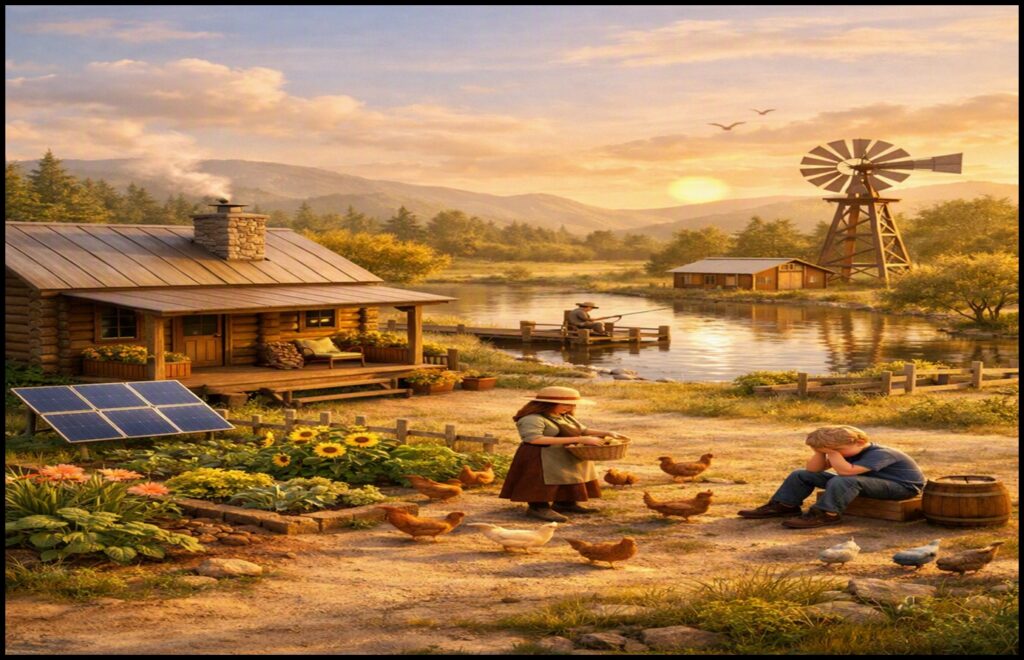
A good off-grid homestead works like a living circle. Kitchen scraps feed the compost. Compost feeds the soil. Soil feeds the garden. The garden feeds the family and the animals. The animals help fertilize the land. Around and around, it goes, like nature’s own little recycling program, except with more chickens.
To build real self-reliance, an off-grid farm usually needs four main pillars:
- Energy Independence: Solar panels, battery storage, wind turbines, micro-hydro systems, or backup generators can help keep the lights on without depending fully on the public grid. The goal is not to power a luxury mall in the woods, just to meet the household’s real needs.
- Water Security: Water matters more than almost anything. Wells, rainwater catchment, storage tanks, filtration systems, and gravity-fed setups can help a household stay prepared when municipal water is unavailable.
- Food Sovereignty: Growing vegetables, planting fruit and nut trees, raising chickens, keeping bees, or managing small livestock can help reduce grocery dependence.
- Waste Management: Septic systems, greywater use, careful composting, and responsible waste handling help keep the homestead clean, healthy, and sustainable.
The key is to start small and build skills over time. Nobody wakes up one morning as a master gardener, solar technician, livestock whisperer, and pressure-canning champion. Most people learn one project, one season, and one mistake at a time.
Strategic Blueprint for Self-Sufficiency
Transitioning to off-grid living takes planning, patience, and a realistic budget. It is less “throw the phone in the pond and become a pioneer by Thursday” and more “learn, prepare, test, improve, repeat.” The blueprint below keeps the process practical and grounded.
- Secure Land and Legal Autonomy: Look for property with usable soil, reliable water access, strong sunlight, and enough space for gardens, animals, storage, and future projects. Check zoning, building rules, water rights, and local restrictions before falling in love with the view.
- Establish Water Sovereignty: A well, rainwater catchment system, storage tanks, and dependable filtration can create a strong foundation. Water should be treated like the star of the show, because without it, the garden cannot grow, livestock cannot feed, and the household or members cannot stay clean.
- Build an Independent Power Grid: Start by calculating what the household truly needs to run. A solar setup with batteries is common, but wind, micro-hydro, or a backup generator may also make sense depending on the land. The best system is one that is simple enough to maintain and strong enough to handle real life.
- Cultivate High-Yield Food Systems: Raised beds, greenhouses, orchards, herb gardens, perennial crops, and small livestock can all work together. Chickens are often a friendly first step because they provide eggs, pest control, compost help, and occasional backyard entertainment.
- Master Food Preservation and Storage: Canning, dehydrating, fermenting, freezing, smoking, and root cellaring help stretch the harvest through the year. Growing food is wonderful, but preserving it is what keeps you from eating twelve zucchinis in one weekend because “they were ready.”
The Reality of the Radical Return
Self-sufficiency sounds peaceful, and often it is, but it is not effortless. Pipes freeze. Gardens fail. Animals escape. Tools break at the worst possible time. And yes, sometimes the thing you carefully built will immediately teach you why version two needs to be better.
Even so, there is something deeply satisfying about knowing how to provide for yourself. Eating food grown on your own land, collecting rainwater, heating with wood, preserving the harvest, or keeping lights on through your own power system can bring a quiet confidence that modern convenience does not always offer.
Living off grid does not have to be extreme. It can begin with a garden bed, a few rain barrels, a pantry shelf, basic tools, a compost pile, or simply learning how everyday systems work. The point is not perfection. The point is becoming more capable, more grounded, and a little less helpless when the lights flicker.
So, if the age of AI and technology ever takes an unexpected nap, could we live without it? Maybe not overnight. But with patience, skills, community, and a good sense of humor, we can absolutely learn. And if all else fails, at least we will know who remembered to plant potatoes.