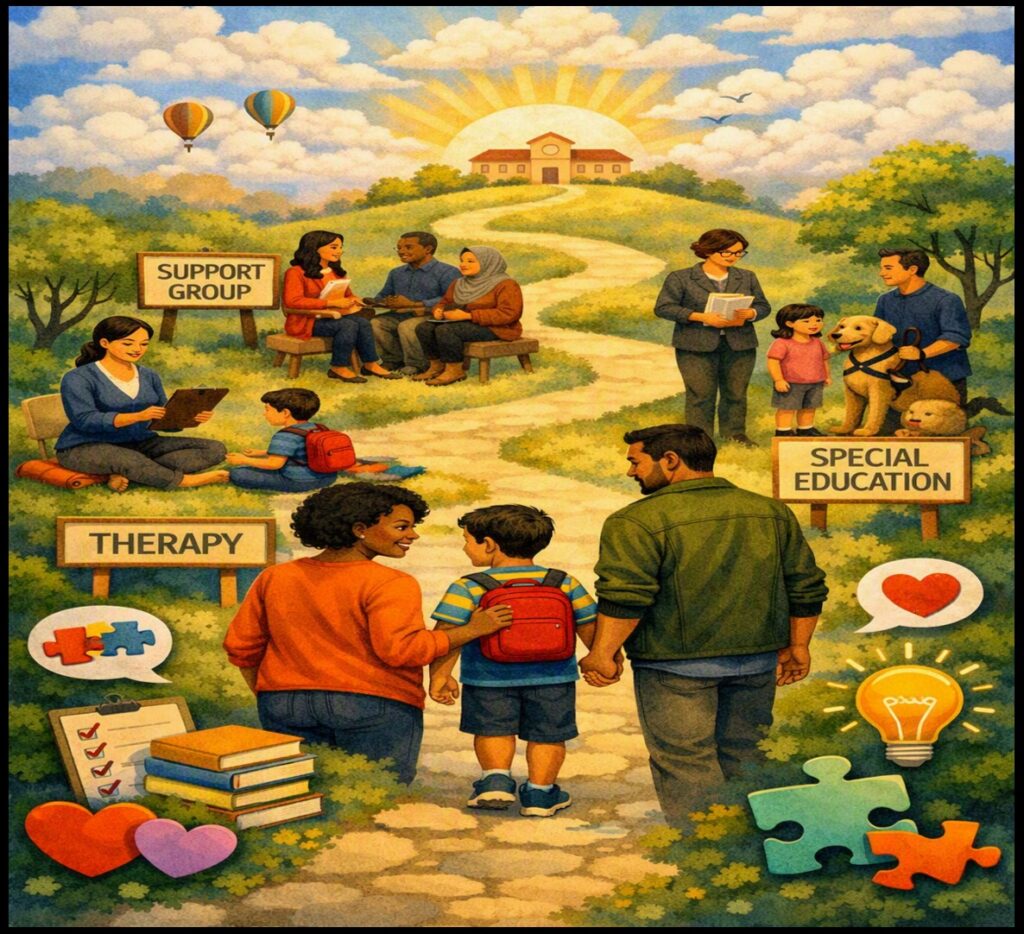
Disclaimer: The information in this article is based on the author’s experience navigating special services for their child and should be treated as a guide only. The autism spectrum is different for every child, so every service provided is individualized. As a reminder, you are your child’s biggest advocate, and you have the right to ensure they receive the best services to meet their needs. Last, DO YOUR RESEARCH and stay informed on the latest resources available in your community. Look to your child’s coordinator. They are there to answer any questions you may have, such as financial, respite, housing, and employment training services. Remember you are not alone; ask for help and gather your support system.
When your child is diagnosed, or suspected, of being on the autism spectrum, the journey ahead can feel overwhelming. You’re not just seeking answers; you’re seeking support, understanding, and a path that helps your child thrive. In New Jersey, there are strong systems in place to guide families through medical evaluations, school services, and adult transitions. This article breaks down each step with clarity and compassion, so you can move forward with confidence and peace of mind.
Step 1: Begin with Your Primary Doctor
Your child’s pediatrician or family doctor is the first stop. Share your concerns openly, whether they involve communication delays, sensory sensitivities, or social challenges. Ask for a developmental screening and a referral to a developmental pediatrician, child psychologist, or neurologist for a formal autism evaluation. A written summary from your doctor noting “suspected autism spectrum disorder” can help you access school and state services later.
Step 2: Get a Formal Evaluation
A comprehensive evaluation confirms the diagnosis and identifies your child’s strengths and needs. Where to go:
- Hospital or university centers (Rutgers RUCARES, Children’s Hospital of Philadelphia satellite clinics, local children’s hospitals)
- Private specialists in developmental pediatrics or child psychology
- Insurance directories under “autism evaluation” or “developmental pediatrics”
For younger children (birth–3): Contact the New Jersey Early Intervention System (NJEIS) at 888‑653‑4463 for home-based therapies.
For ages 5–21: Reach out to PerformCare at 1‑877‑652‑7624 for behavioral and in-home supports through the Children’s System of Care (CSOC).
Step 3: School Evaluation and Support Plans
Write to your school district’s Child Study Team requesting a comprehensive evaluation for special education eligibility. If your child qualifies, they’ll receive either:
- An IEP (Individualized Education Program) for specialized instruction and related services, or
- A 504 Plan for accommodations only.
Every three years, the school must conduct a reevaluation to ensure services remain appropriate. Ask for inclusion opportunities, in-class support teachers, and paraprofessionals when needed. The goal is always the least restrictive environment; this includes learning alongside peers whenever possible.
Step 4: Transition Planning and Graduation
By age 14 (and no later than 16), your child’s IEP should include a transition plan for life after high school. This plan covers vocational training, community experiences, and independent living skills. Before graduation, confirm that your child’s final reevaluation includes adaptive and functional assessments; these are essential for adult services.
Step 5: Division of Developmental Disabilities (DDD)
DDD provides financial adult services starting at age 21. Apply around age 18 to ensure a smooth transition. Signing up for DDD services is crucial for families as it provides access to a wide range of support services, including case management, residential services, family support, day programs, and supported employment services. These services help individuals with developmental disabilities live as independently as possible and support their families in navigating the system.
-Time to File: Ideally, the Child Study Team case manager will present the opportunity for families to sign up for DDD services during their child’s annual IEP meeting or when it’s time to form a transitional program before graduation. Everyone should consider signing up for DDD services before graduation. Services include:
- Support Program (day programs, in-home supports, respite care)
- Vocational Programs (help with job readiness)
- Community Care Program (CCP) (residential and intensive supports)
How to apply:
- Obtain NJ FamilyCare (Medicaid) coverage.
- Complete the DDD intake application and NJCAT assessment.
- Contact your DDD regional office (listed by county on the NJ Department of Human Services website).
The Arc of New Jersey Family Institute offers free help with applications and NJCAT preparation.
Step 6: Division of Vocational Rehabilitation Services (DVRS)
DVRS helps individuals with disabilities prepare for and maintain employment. Services include vocational counseling, job training, and college or trade school support. Connect with your local DVRS office (search “NJ DVRS [your county]”) during high school transition years or after graduation.
Step 7: Paid Caregiver Options (Mention Fresh Start Health Care to your child’s coordinator)
Some Medicaid and DDD programs allow family members to be paid caregivers through self-directed services. Ask your DDD support coordinator or NJ FamilyCare representative about Personal Care Assistant (PCA) or self-direction options.
Step 8: SSDI, SSI, and Medicaid
SSI (Supplemental Security Income) supports children and adults with disabilities and limited income. At age 18, eligibility is based on the young adult’s income, not the parents’. SSDI (Social Security Disability Insurance) may apply if a parent receives Social Security benefits. Apply through SSA.gov or your local Social Security office. Ensure your child has NJ FamilyCare (Medicaid); it’s required for most DDD programs and covers medical and therapy services.
Step 9: Advocacy and Support Networks
SPAN Parent Advocacy Network
- Offers free workshops and one-on-one guidance for IEPs, transitions, and advocacy.
- Phone: (800) 654‑7726
- Website: SPAN Parent Advocacy Network | Empowered Parents: Educated, Engaged, Effective!
Division of Developmental Disabilities (DDD) Full Application
Disability Rights New Jersey (DRNJ)
- Provides legal advocacy for disability rights and service disputes.
- Website: NJ’s Designated Protection & Advocacy Agency | Disability Rights New Jersey
Autism New Jersey and The Arc of New Jersey
- Offer statewide resources, helplines, and family support for navigating DDD and adult services.
- Website: The Arc of New Jersey | Developmental Disabilities Services & Support
Step 10: County Contacts
To find local offices:
- DDD Regional Office: Search “NJ DDD [your county] regional office.”
- DVRS Office: Search “NJ DVRS office [your county].”
- SPAN County Projects: Visit SPAN’s website and select your county.
- NJ FamilyCare Office: Search “NJ FamilyCare county office [your county].”
Conclusion
If you’re walking this path, know that you’re not alone. Every phone call, meeting, and evaluation is a step toward building a stronger foundation for your child’s future. The process can be long, but each milestone, each new service, each supportive teacher, each advocate, represents progress and hope.
You’ve already shown incredible strength by seeking answers and support. Remember how far you’ve come, how much love you’ve poured into your child’s journey, and how many doors you’ve opened through your persistence. With faith, patience, and community, your child can thrive, and you can find peace knowing you’ve done everything possible to help them shine.